

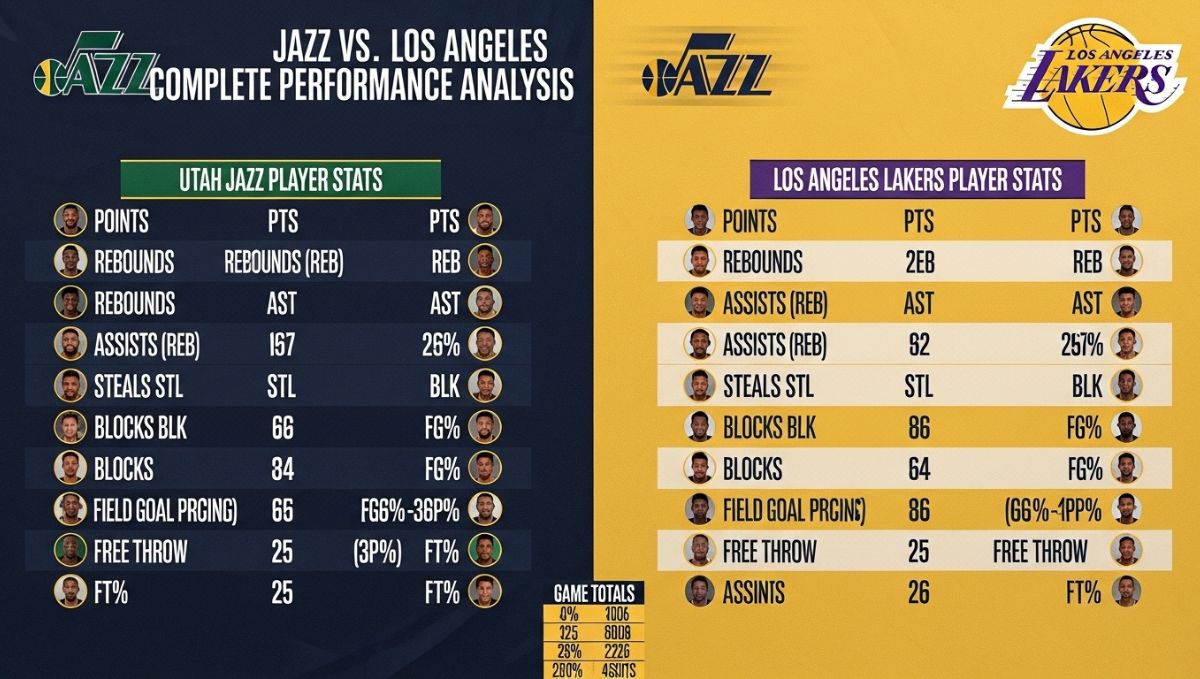
The rivalry between the Utah Jazz and the Los Angeles Lakers has always drawn attention from basketball fans, analysts, and sports media. Every matchup between these two NBA teams offers a blend of strategy, star power, and competitive intensity. One of the most discussed aspects after each game is utah jazz vs lakers match player stats, as these numbers reveal how individual performances shape the outcome of the contest.
Player statistics go beyond basic scoring. They reflect efficiency, defensive effort, teamwork, and overall influence on the game. By examining these metrics closely, fans can better understand why a team wins or loses and how key players contribute on both ends of the court.
Importance of Player Stats in Jazz vs Lakers Games
In high-profile matchups like Jazz vs Lakers, player stats serve as a roadmap of the game. They help identify momentum shifts, mismatches, and standout performances.
Key reasons why utah jazz vs lakers match player stats matter include:
-
Evaluating star player impact
-
Understanding team strategies
-
Measuring efficiency and consistency
-
Highlighting defensive and bench contributions
These stats often influence post-game discussions, rankings, and future game planning.
Offensive Performance Analysis
Lakers Offensive Contributions
The Lakers traditionally rely on star-driven offense combined with inside scoring and transition play. Player stats in these games often highlight:
-
High field goal attempts from primary scorers
-
Strong paint scoring and post efficiency
-
Assist numbers reflecting ball movement
-
Free-throw attempts generated through aggressive drives
When analyzing utah jazz vs lakers match player stats, Lakers offensive success is usually tied to shot selection efficiency and playmaking from their core players.
Utah Jazz Offensive Execution
The Utah Jazz are known for structured offense, spacing, and perimeter shooting. Their player stats often emphasize:
-
Three-point shooting efficiency
-
Balanced scoring across the lineup
-
Assist-to-turnover ratio
-
Off-ball movement leading to open looks
In many matchups, Jazz player stats reveal how teamwork and spacing challenge the Lakers’ defensive schemes.
Defensive Player Stats and Their Impact
Lakers Defensive Metrics
Defensive stats play a major role in determining the flow of Jazz vs Lakers games. Lakers defenders are often evaluated based on:
-
Steals and deflections
-
Defensive rebounds
-
Blocks at the rim
-
Opponent shooting percentage
In utah jazz vs lakers match player stats, strong Lakers defense usually correlates with fast-break opportunities and momentum swings.
Jazz Defensive Performance
Utah Jazz defensive player stats typically focus on discipline and positioning. Key indicators include:
-
Contesting perimeter shots
-
Defensive rebounding consistency
-
Rim protection efficiency
-
Fouls committed versus stops generated
These defensive metrics show how the Jazz attempt to control pace and limit the Lakers’ scoring runs.
Star Player Comparison
Lakers Star Players
Star players on the Lakers often dominate statistical categories such as points, rebounds, and assists. Their match player stats usually reflect:
-
Usage rate and scoring efficiency
-
Playmaking responsibilities
-
Leadership during critical moments
-
Impact during clutch situations
In utah jazz vs lakers match player stats, Lakers stars are often the focal point of defensive attention, making their efficiency especially important.
Utah Jazz Key Players
Utah Jazz key players contribute through versatility and consistency. Their stats often highlight:
-
Efficient scoring without excessive usage
-
Defensive versatility
-
Floor spacing through shooting
-
Contribution to team-oriented play
Comparing Jazz and Lakers stars through player stats provides insight into contrasting basketball philosophies.
Bench Player Statistics
Lakers Bench Contributions
Bench player stats are often overlooked but can be decisive. Lakers bench analysis typically includes:
-
Scoring bursts that maintain leads
-
Defensive energy and hustle stats
-
Plus-minus ratings reflecting on-court impact
In several utah jazz vs lakers match player stats breakdowns, bench scoring has proven critical during non-starter minutes.
Jazz Bench Impact
The Jazz bench is often valued for consistency and discipline. Bench player stats may show:
-
Efficient shooting in limited minutes
-
Low turnover rates
-
Solid defensive positioning
These contributions help stabilize the game and support the starters effectively.
Rebounding and Interior Control
Rebounding stats are a crucial part of utah jazz vs lakers match player stats. They determine possession control and second-chance opportunities.
Key rebounding metrics include:
-
Offensive rebounds leading to extra points
-
Defensive rebounds limiting opponent chances
-
Team rebounding balance
The Lakers often focus on physical rebounding, while the Jazz emphasize positioning and team rebounding strategies.
Playmaking and Assist Distribution
Assist stats provide insight into offensive flow and teamwork.
Lakers Playmaking Stats
Lakers assists often come from primary ball handlers and transition play. High assist numbers typically indicate:
-
Effective pick-and-roll execution
-
Strong inside-out passing
-
Good rhythm in half-court offense
Jazz Ball Movement
Jazz assist stats usually reflect system-based offense. This includes:
-
Extra passes for open shots
-
Ball movement across the perimeter
-
High assist-to-field-goal ratios
These differences are clearly visible when reviewing utah jazz vs lakers match player stats.
Turnovers and Efficiency Metrics
Turnovers can drastically shift momentum. Player stats related to efficiency include:
-
Turnover count
-
Assist-to-turnover ratio
-
Shooting percentages
-
Usage efficiency
In Jazz vs Lakers games, the team with fewer turnovers often controls tempo and limits fast-break points.
Clutch-Time Player Stats
Clutch moments define marquee NBA matchups. Utah jazz vs lakers match player stats in clutch situations often focus on:
-
Field goal percentage in final minutes
-
Free-throw accuracy under pressure
-
Defensive stops
-
Decision-making efficiency
These stats highlight which players perform best when the game is on the line.
Advanced Analytics Perspective
Beyond traditional stats, advanced metrics provide deeper insight.
Common advanced stats include:
-
Player efficiency rating (PER)
-
Plus-minus impact
-
Defensive rating
-
Usage efficiency
Advanced analysis of utah jazz vs lakers match player stats helps explain contributions that may not appear in basic box scores.
Coaching Influence on Player Stats
Coaching strategies significantly affect player statistics. Rotations, defensive schemes, and offensive sets shape how players perform statistically.
Jazz coaching often emphasizes:
-
System execution
-
Balanced scoring
-
Defensive discipline
Lakers coaching may focus on:
-
Maximizing star player output
-
Matchup exploitation
-
Transition opportunities
These approaches are reflected clearly in match player stats.
Fan and Media Interpretation of Stats
Fans and analysts closely examine jazz vs lakers match player stats to debate player value, team strength, and playoff potential. Media narratives often emerge based on standout statistical performances.
Stat lines influence:
-
Player rankings
-
Award discussions
-
Trade rumors
-
Team evaluations
This makes player stats a central part of post-game analysis.
Conclusion
Utah jazz vs lakers match player stats provide a detailed picture of how each game unfolds. From star performances and bench contributions to defensive metrics and advanced analytics, these stats tell the story behind the scoreboard.
By analyzing player stats thoughtfully, fans gain a deeper appreciation of team strategies, individual effort, and overall game dynamics. Whether it’s offensive efficiency, defensive impact, or clutch-time execution, player statistics remain essential for understanding the true outcome of every Jazz vs Lakers matchup.